18 September 2012

Tiny Targets


I got this idea from a friend of mine who recently introduced it into her class. My class has been talking about their families and who lives in their houses, so a way for us to document what the children have said is to put up their photos on our Tiny Target poster with a speech bubble of their words. The actual target is laminated and blue-tacked onto the blue card so I can change the target easily as needed. I have laminated speech bubbles that I can easily write on with dry-wipe pens so I can reuse them.

I was speaking to my friend who came up with "Tiny Target," and she said she also made up stickers with the target typed on so she can easily pop them into their Learning Journeys/Portfolios/etc. as a permanent record of their progress. Super idea!

16 September 2012

Let the Children Jump


Jumping is such a simple and easy activity for children to do, and yet is offers so many benefits to their gross motor development, their health, and interacting with others (at least in the context my class were jumping in the other day).


Look at the line of children waiting for their turn to jump off the box. I had no involvement in this "rule" the children imposed on their play. They naturally came to the conclusion that the best way for everyone to get a shot at jumping without everyone clamoring in each others' way was to form a line and take turns. (Most) children have a natural inclination towards rules, right/wrong, and fairness. Watch them when they make up games independently of adult support. Rules are a natural addition to their play.


Jumping offers great gross motor development practice. The children experimented with different ways to jump off the box. Most chose to jump with both feet facing forward. Some adventurous types spun in the air, while others did the splits in the air! Some who were a little more hesitant, but wanted to join in the jumping fun, chose to simply step off the box onto the mat. Landing also offered great gross motor opportunities; keeping your balance after a big jump is quite a skill, and not all the children were able to master it yet. Fortunately, they loved doing a little roll on the mat as they landed.


Getting children away from the screens and moving around can be a challenge. Offering a stimulus for active play is often all it takes to get children moving. All I did was pop a few boxes outside with a mat and the children did the rest.

Happy jumping!

15 September 2012

The Body: Child-Led Learning


A few weeks ago, I wrote a post about mark-making which showed different stages of drawing people. One of the examples depicted people with legs coming out of their necks, which is quite a common thing for children to do when drawing people.

As a result of this, I thought a good way to progress the children's understanding of the body would be to look at it a little closer and learn about all the different parts. First, we traced someone's body:


Then we made a mind map of what we know about the body. Unfortunately, I don't have a photo of the mind map right now, but essentially, it says "bodies" in the middle and the children drew pictures, shared ideas, and wrote words all about the body. One wee boy said that we all have a love heart in our bodies! Another boy prefers writing to drawing, so he wrote words like "feet," "chin," "back," "eye," "eye," (yes, twice, because we have two eyes) "body," and "nose." He wrote it all with minimal support!

Next, we took photos of different parts of our body. The children were in charge of deciding what body parts to photograph and they were in charge of actually taking the photo. The more responsibility the children have, the better.


After we printed the photos, some children helped to make labels for them and we stuck them up on the cut out body tracing on the wall.

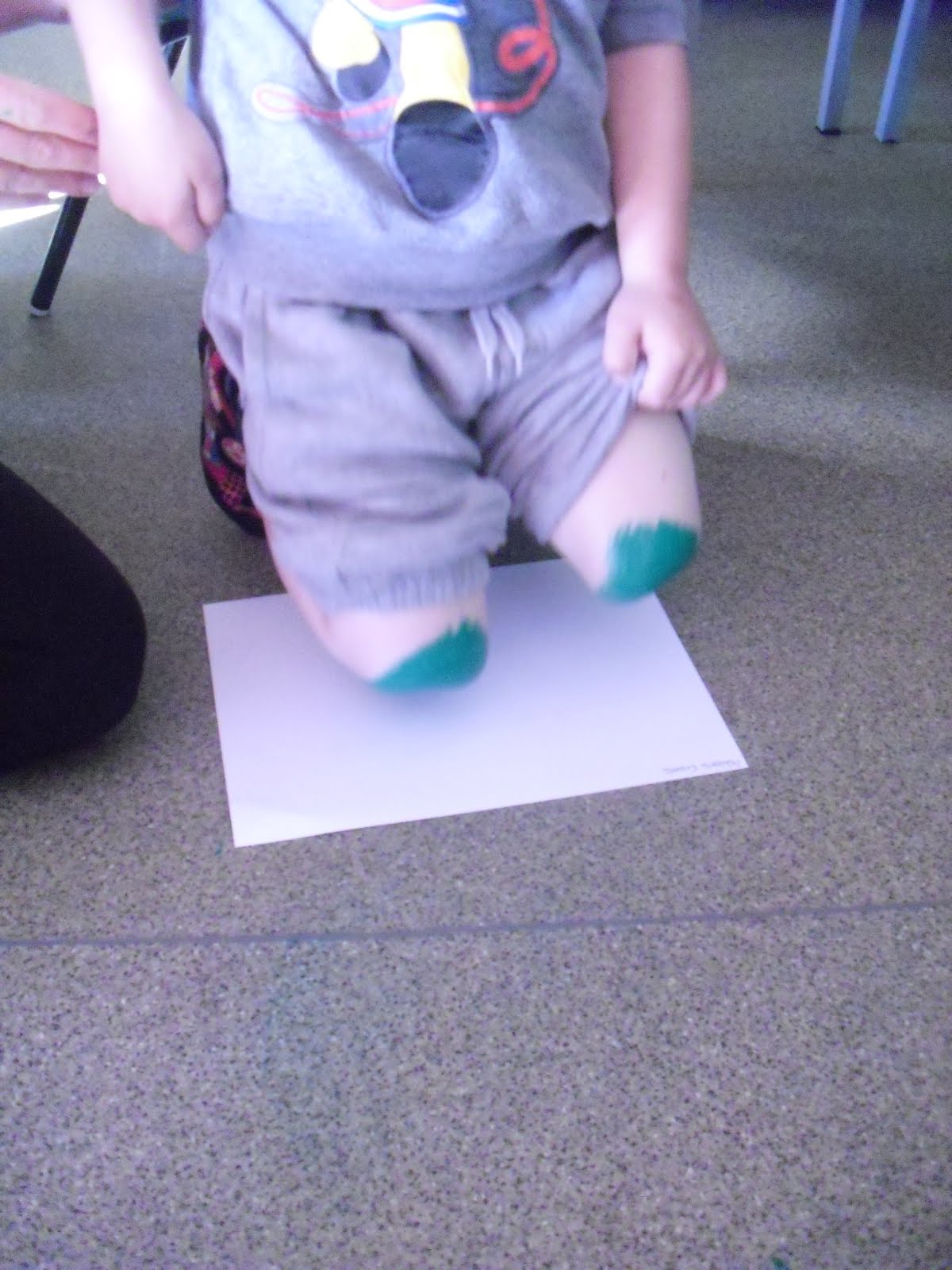
Simultaneously, there was a body painting activity going on. The children chose what body part they wanted to print onto paper with paint:


The body painting was so popular, we had to bring the activity outside for some collaborative foot printing:


The paint trays got a little slippery, so there may have been some painty bottoms! If you do this activity with your class, make sure you have some tubs of warm, soapy water, towels, and chairs handy for the clean up!

Speaking of clean up, always get the children to be responsible for cleaning up their own messes. It's their classroom, so they should be responsible for it to have a sense of ownership.


Phew. All that from a drawing of legs coming out of a head! And we're not done yet! The children have shown an interest and knowledge about bones and the heart. I'm hoping to extend their learning experiences with this interest in mind.

Note, these activities did not all take place in the same day. These occurred over the course of a week or so, always adding and extending learning experiences based on things the children said, did, or asked about.

08 September 2012

Natural & Open-Ended Resources


How many times have you set out resources for your kids to use, and they haven't used them according to your expectations? How often do we see educational toys that are designed with only one use in mind? Pirate ship play-grounds can be exciting and look really neat, but they limit the type of play that can occur. A pirate ship play-ground will ultimately result in pirate play. There's nothing wrong with pretending to be a pirate. I can "yar me harty" with the best of them. But as educators, we should be encouraging children's natural curiosity, creativity, and need to explore, and one of the best ways we can nurture that is through open-ended resources.


With open-ended or natural materials, children can explore, create, imagine, and learn through play without the resource dictating what their play should be. I'm always surprised at what children's imaginations come up with; it's often not at all what you intended, and that's okay!


After a short "stick safety" chat, the children had free reign of our collection of sticks, branches, driftwood, and medallions. Someone discovered the flower box and decided to add a floral finishing touch to their creation.

Sadly, children don't always have the opportunity to use their imaginations in their play. With video games, computers, and ready-made toys, children have all the heavy lifting done for them.


With natural and open-ended materials, children can do the heavy lifting all on their own.


Or with a little help from a friend.

27 August 2012

Development in Mark Making

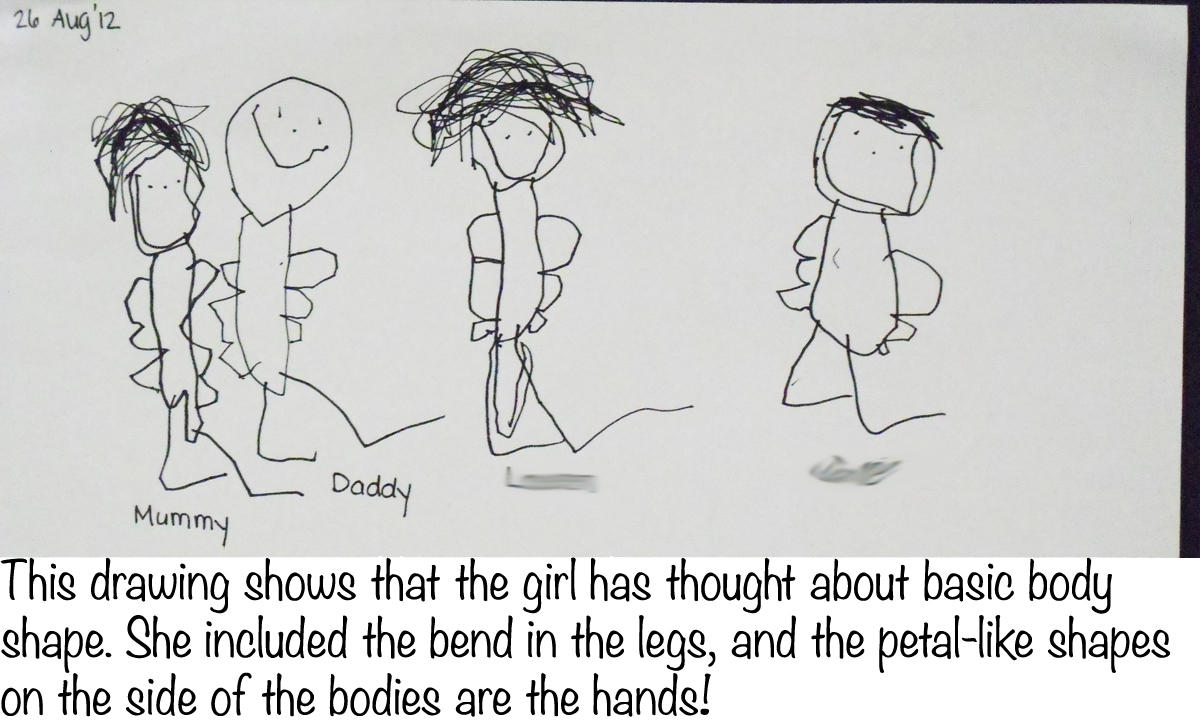
This week we are talking about our families and who lives in our houses. The children all did black pen drawings of their families. We made sure to talk about facial features and other body parts that we could include in the drawings. Some children even included pets!
I've posted some of the children's drawings here to show different stages in the development and progress of mark-marking.

Although this drawing shows the added development of actual writing, the drawing itself depicts very basic features. Children often focus on the face and leave out the rest of the body when they are in the early stages of drawing people. I call this the "floating heads" stage.

This one cracks me up!

This is quite a common stage in drawing people as well - the legs growing straight out of the head.


"The preschematic stage stage of drawing is the first conscious creation of form which provides a tangible record of the child's thinking process. The first representational attempt is a person, usually with circle for head and two vertical lines for legs. Later other forms develop, clearly recognizable and often quite complex. Children continually search for new concepts so symbols constantly change." -learning design


This week, we are taking photos of the children with the person who drops them off to continue our families display. We've also asked parents to bring in photos of their families to help with "family vocabulary" like "brother," "sister," "uncle," and "grandmother."

As a result of some of the drawings that lack body parts, we are going to be tracing our bodies to create a display. We will label basic body parts, take photos of our hands, legs, feet, elbows, etc. and discuss where we can put them on the body tracing. We will also use mirrors again to help us become more familiar with what our bodies look like. I can't wait to see their drawings after all this focus!

26 August 2012

A Seashell


J. found a shell in the garden! What a great discovery. He noticed the lines on the shell, and imagined it came from a place called "Shell-land."


J. found another shell in the sand pit. It had dirt stuck inside it. He used the first shell as a spade to dig it out, and rinsed them in the sink.

At Circle Time, the children gathered to look at, feel, and smell the shell. Some children said they've seen shells at the beach, others said the shell felt rough and had lots of lines. We had some great discussion about what the children like to do at the beach and who they go with. We even had some discussion about how the seashell came to be in the garden. Some children thought a seagull dropped it there. All the children had something to contribute because it was something they could all relate to. It was great having an impromptu Circle Time with the children about one of their own discoveries. That's was Pre-School should be about.