Showing posts with label Literacy. Show all posts

17 February 2014

Mark Making: Engaging the Uninterested


I teach 3 and 4 year olds, and it's my responsibility to help prepare them to start school. One of the things I've asked current Primary 1 teachers is what they want the kids to be able to do when they come to them from Nursery. One of the resounding requests is that the children know how to hold a pencil and are at least beginning to make marks that resemble symbols and letters. This is tricky business when Nursery is all about free choice, free flow, and freedom. If I can't take the children to the drawing table, I have to take the drawing table to them.

1. Use different mediums and resources. Some children aren't at the stage where they feel confident with traditional writing tools like pens and pencils. Touch screens are a great way to engage hesitant mark makers. They don't have to fumble with a writing tool, and they can instantly start a new picture.


2. Provide interesting props, resources, and tools. Sometimes all it takes is some interesting prop or picture or thingamabob. Other than pens and pencils, what are you putting out on your drawing table? Maybe just the pens and pencils aren't motivational enough to bring those hesitant mark makers over. I've provided photos, mirrors, word mats, books, toys, staplers, stampers, hole punchers, tubs with things related to an interest, vegetables, shells, keys, pebbles, lego, stickers... The list could go on.


3. Change the location. Mark making doesn't have to happen at the drawing table, or any table for that matter. Look around your room; where are your kids playing? Neatly at a table or sprawled across the floor? In this particular example, I taped a huge piece of paper to the floor and provided paint and brushes. The children listened to music as they painted what the music made them feel or think. On other occasions, I've simply left the large paper taped to the floor and let the children create in any way they wanted. Large movements help develop skills necessary to eventually make smaller movements on smaller paper.


4. Make a mess. Kids love getting messy, so use that to your advantage. The shaving foam is very popular in my room, and although you can't keep the evidence of mark making, it's still happening and developing those important fine motor skills. Take lots of photos!


5. Take it outside. The outdoors offer a lot of opportunities to mark make. Chalk, puddles & brushes, puddles & wheels, leaves, sticks, pebbles, grass all offer opportunities to mark make in a less traditional sense.


In the end, don't fret. Your kids will learn how to hold a pencil. They will learn how to write. But they need the opportunity to explore mark making in different ways before they're forced to actually write words and numbers and letters. They need that time to learn that marks and print can have meaning, and to begin to attribute meaning to their own work. Chances are, they'll be able to hold a pencil by the time they get to Primary 1, and most will be able to write their name and copy print. Just give them time to have fun and explore.


Happy Mark Making!

30 November 2013

Story Writing in the Early Years: Stepping Stones


The other day I sat down with a basket full of whiteboards, pens, and rubbers, and 5 children came to sit with me intrigued by this new resource. We had a small discussion about what we could do with the whiteboards. They liked that they could rub out their pictures if they weren't happy with it. The conversation turned to what they could draw on the boards and a story began to emerge.


There were a flurry of ideas about a dinosaur in a volcano, with a "coconut tree" nearby. The children discussed where this should all take place:

"The volcano is outside. It can't be inside."

"Dinosaurs lived a long time ago."

"There should be trees."

"A jungle!"

Unfortunately the dinosaur (later to be a Stegosaurus) got caught in the volcano and needed to be rescued. I said, "How will the dinosaur be rescued from the volcano?"

"Superheroes rescue people."

"Batman will help him."

"And Superman."


"Batman can go 'whoosh!' and pick up the dinosaur from the lava."

Me: "Where will they go?"

"They fly to a car to get away."


The children were engaged in their drawings as they talked about their story. The drawings evolved as their ideas became more complex and the story unfolded. The dinosaur couldn't fit in the car and Batman had to drive. Ropes were involved to attach the dinosaur to the roof of the car. And where did the car go?


Well, unfortunately even though the dinosaur was rescued from the perils of the volcanic heat, he was met with a rogue soldier who decided to take matters into his own hands. Batman and Stegosaurus didn't make it.

"The soldier comes and shoots them both. Bang! It wasn't real bullets. Just pretend."

One mum said it was video games, but she's glad her son was writing stories!

The kids were so engrossed in their story and they had very little input from me. The only stimulus they had were the whiteboards and their imaginations. This process could be developed further by providing props, pictures, or story books to inspire their ideas.

I was so proud of their story and we practiced telling it together, then headed into the "big school" to read it to our Depute Head. They were to thrilled to share their hard work and even got a wee sticker to reward their accomplishment.

Story writing in the Early Years doesn't have to be tricky. In fact, the children are story writing all the time in their role play. They imagine a certain environment, a particular scenario, and a variety of characters. They put themselves in the story and act it out with their friends or by themselves. Offering a role play stimulus, whether it's a kitchen, a doctor's surgery, Santa's Toy Shop, or simply offering open ended items, encourages story telling through drama - oral story telling if you will. Storytelling is a process for children and should be introduced as stepping stones. It may appear that the children are simply "playing," but they are in fact exploring roles, creating stories, honing social skills, and practicing vocabulary. These are important skills for children to learn in preparation for school. Then, perhaps they'll start drawing pictures of these stories or making marks to represent the writing in their story. Adults may scribe what they say to document their story. Eventually, in school the children will begin writing their stories. Stepping stones.

Happy story writing.

15 May 2013

Reading Group Management

"Mrs. West, can I go to the water fountain?"

"Mrs. West, what do I do now?"

"Mrs. West, I'm stuck."

"Mrs. West, I like dogs."

Sound familiar? During reading groups, I expect my kids to get started with their jobs right away and stay on task while I meet with reading groups. However, there's always a handful of children who vie for my attention in one way or another, and I end up with a string of 8 year olds at my elbow: "Mrs. West. Mrs. West. Mrs. West." Ignoring them just didn't seem to give them the message.

On Monday, we had a chat about what their responsibilities are during reading groups, and what mine are. We decided on the following:

Pupils will:
1. Get started right away
2. Stay on task
3. Use soft voices
4. Think what makes sense

Teacher will:
1. Meet with reading groups
2. Ask questions
3. Give praise
4. Give advice

Pretty great list from a group of 8 year olds, if you ask me. Number 4 on the pupil's responsibility list was the most important for this particular discussion. We added that one in because sometimes they just need a reminder that they need to think for themselves before coming to speak to me. We talked about how they need to think, "do I really need to ask this question right now?" and "What makes sense for me to do right now?" The children are always given enough information and tasks to keep them going for the whole reading session, so they shouldn't be asking me "what do I do now?" (Does anyone else hate that question? I have a whole display in my class called the "I'm Done" board with choices for them to choose from when they're finished).

Even after our discussion, though, I still thought the kids might need a visual reminder that they need to think before coming to me. It's not fair to interrupt another group's time with me! I found this cute lantern at ASDA (Scottish version of Walmart), and I keep it with me during reading groups. When the light is on, the kids know that I'm only available to the reading group I'm meeting with. I turn off the light when I'm transitioning to a new group. That way any pressing issues can be dealt with quickly before I meet with my next group.


So far, it's worked really well. The kids have really seemed to "get" it that I'm busy and that they need to think for themselves or ask a friend before coming to me. When I turned on the light with one reading group today, a wee girl said, "Yes! No one can bother us now!" I'm glad she enjoys our time together so much!

07 May 2013

Book Detectives: Reciprocal Teaching

Book Detectives is an amazing resource that I use during reading groups. It's not my idea (it came from Moray Council Aberdeenshire Council in Scotland), but I have made it my own and established it in my classroom routines.


The above task cards are developed by me using the Book Detective roles. I created Learning Intentions and Success Criteria to go with every role. On the back, there are examples, questions to consider, or other prompts to help pupils fulfill the success criteria.

I implement these task cards in different ways. I have 4 reading groups. Each reading day, I meet with 2 reading groups (by the end of the week, I meet with each group twice. We have 4 reading days). Every reading group is given a task from the Book Detectives ring that they must complete. Sometimes each group has the same task, sometimes different ones, depending on the book they're reading or the skills they need to practice. With older children, I would slowly train them to become more independent with the roles/tasks and have each member of the group fulfill a role and feedback to their reading group. I'm no where near that with my current class, but maybe some time in the future with a more able class I will be able to implement Book Detectives that way.

How do you implement and organise your reading groups?


15 September 2012

The Body: Child-Led Learning


A few weeks ago, I wrote a post about mark-making which showed different stages of drawing people. One of the examples depicted people with legs coming out of their necks, which is quite a common thing for children to do when drawing people.

As a result of this, I thought a good way to progress the children's understanding of the body would be to look at it a little closer and learn about all the different parts. First, we traced someone's body:


Then we made a mind map of what we know about the body. Unfortunately, I don't have a photo of the mind map right now, but essentially, it says "bodies" in the middle and the children drew pictures, shared ideas, and wrote words all about the body. One wee boy said that we all have a love heart in our bodies! Another boy prefers writing to drawing, so he wrote words like "feet," "chin," "back," "eye," "eye," (yes, twice, because we have two eyes) "body," and "nose." He wrote it all with minimal support!

Next, we took photos of different parts of our body. The children were in charge of deciding what body parts to photograph and they were in charge of actually taking the photo. The more responsibility the children have, the better.


After we printed the photos, some children helped to make labels for them and we stuck them up on the cut out body tracing on the wall.

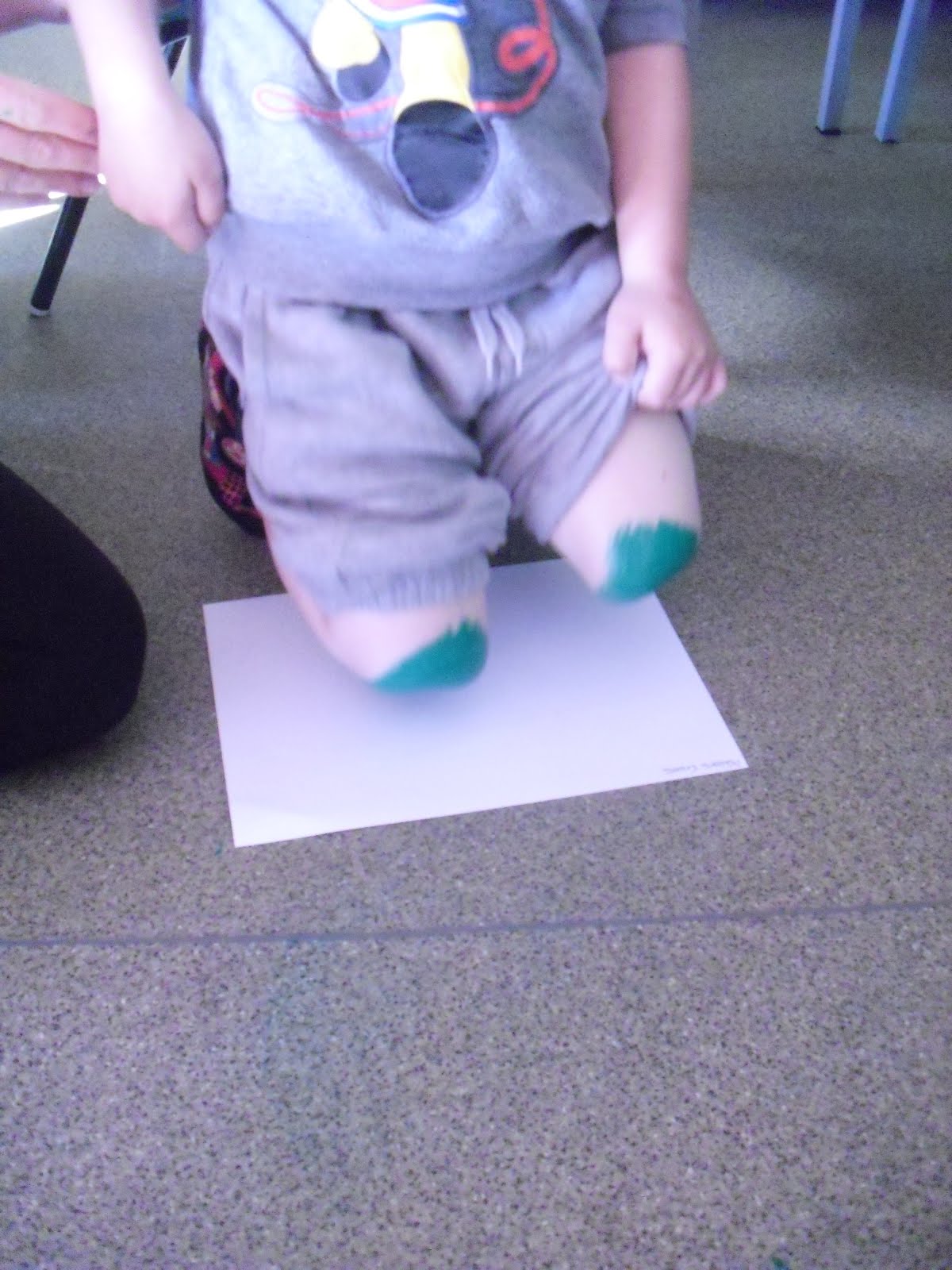
Simultaneously, there was a body painting activity going on. The children chose what body part they wanted to print onto paper with paint:


The body painting was so popular, we had to bring the activity outside for some collaborative foot printing:


The paint trays got a little slippery, so there may have been some painty bottoms! If you do this activity with your class, make sure you have some tubs of warm, soapy water, towels, and chairs handy for the clean up!

Speaking of clean up, always get the children to be responsible for cleaning up their own messes. It's their classroom, so they should be responsible for it to have a sense of ownership.


Phew. All that from a drawing of legs coming out of a head! And we're not done yet! The children have shown an interest and knowledge about bones and the heart. I'm hoping to extend their learning experiences with this interest in mind.

Note, these activities did not all take place in the same day. These occurred over the course of a week or so, always adding and extending learning experiences based on things the children said, did, or asked about.

27 August 2012

Development in Mark Making

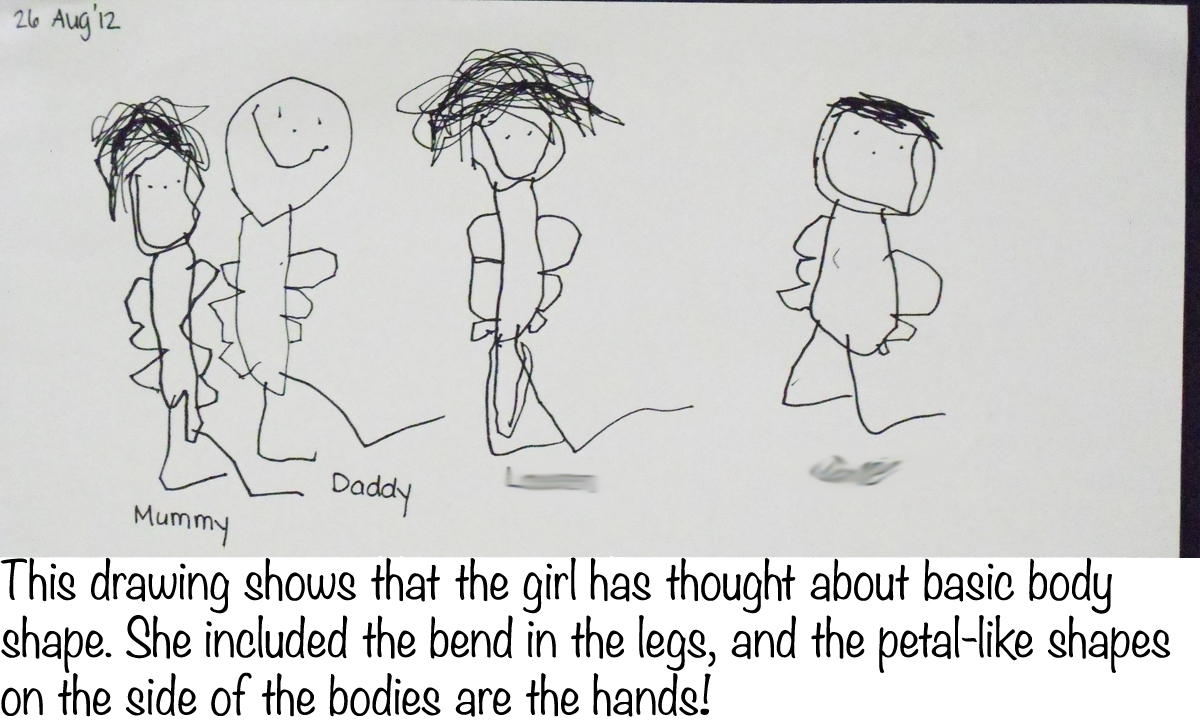
This week we are talking about our families and who lives in our houses. The children all did black pen drawings of their families. We made sure to talk about facial features and other body parts that we could include in the drawings. Some children even included pets!
I've posted some of the children's drawings here to show different stages in the development and progress of mark-marking.

Although this drawing shows the added development of actual writing, the drawing itself depicts very basic features. Children often focus on the face and leave out the rest of the body when they are in the early stages of drawing people. I call this the "floating heads" stage.

This one cracks me up!

This is quite a common stage in drawing people as well - the legs growing straight out of the head.


"The preschematic stage stage of drawing is the first conscious creation of form which provides a tangible record of the child's thinking process. The first representational attempt is a person, usually with circle for head and two vertical lines for legs. Later other forms develop, clearly recognizable and often quite complex. Children continually search for new concepts so symbols constantly change." -learning design


This week, we are taking photos of the children with the person who drops them off to continue our families display. We've also asked parents to bring in photos of their families to help with "family vocabulary" like "brother," "sister," "uncle," and "grandmother."

As a result of some of the drawings that lack body parts, we are going to be tracing our bodies to create a display. We will label basic body parts, take photos of our hands, legs, feet, elbows, etc. and discuss where we can put them on the body tracing. We will also use mirrors again to help us become more familiar with what our bodies look like. I can't wait to see their drawings after all this focus!

31 March 2012

Teachers Pay Teachers

Teachers are known for reinventing the wheel. There are teacher supply stores, ready-made products and resources, books full of photocopiables, free printables online, and yet we spend hours making our own resources from scratch. I'm as guilty as the next teacher. In fact, I'll even admit that I like making my own resources. It drives Mr. West nuts, especially when I spend time on the weekend creating things for my class!

Well, it turns out I'm not the only one who likes to spend their downtime doing teacher-y things. Teachers Pay Teachers is a site where teachers can post their personally-made resources for other teachers to download either for free or for a price. Some of the stuff on there can be pretty useful, and I've recently set up an account of my own to share my handiwork.

There are quite a few languages represented in my class, so I recently made up multilingual Days of the Week posters. You can download your own free set here. The languages depicted are Lithuanian, Polish, Russian, Chinese, Bengali, Urdu, and English.