Showing posts with label construction. Show all posts

26 August 2013

Sticks & Stones

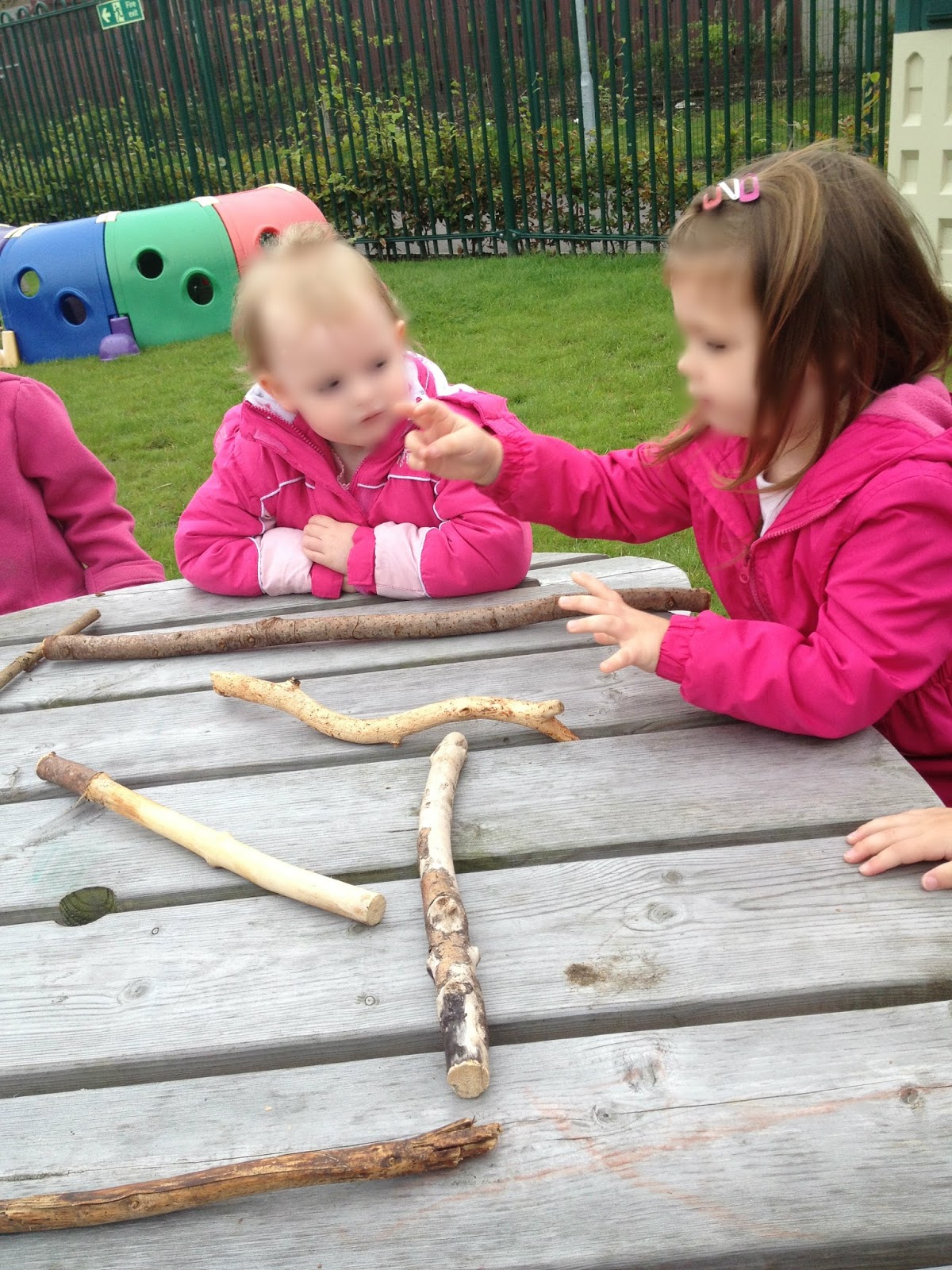
Today I brought out a group of children to explore with sticks. To begin, I simply asked, "how do we play with sticks?" and I got some answers that I expected:

"No running"

"No fighting"

"No smacking faces"

So we got the "No's" covered, but we didn't answer the question: how do we play with sticks? The kids were at a loss. They knew what NOT to do with them, but were uncertain what TO do with them. So to start them out, I just let them choose one stick and I listened to their conversation:

"Mine is bigger than yours."

"Yours is the biggest."

"Mine is bumpy. It has bumps."

"A stick is a tree."

"I can hit mine on the table."

This is when a chorus of stick songs broke out. On their own, the children were able to figure out something they could do with the sticks. After the impromptu jam session, we went around the table to let each child "perform" a stick rhythm and we all tried to copy it.

Next, we decided that sticks were good for making pictures.


The kids took turns putting down one stick to make a picture on the table top.


After our guided play with the sticks, the children were eager to get their hands on more sticks and create on their own. Some of them created small structures on their own, while others worked together to build larger structures on the ground.


Others, however, preferred inspecting the little creatures living in the bag our sticks live in. I see mini-beast houses in our future!

02 February 2013

Houses: A Collaborative Project


This project all started from this one inspiration at the Duplo on Monday. A few children were building houses and I asked them what their houses were like and this attracted a lot of attention and interest. I also asked about different rooms in their houses, but I quickly realised that this was met with some confusion and lack of understanding. Rooms? I got answers like "teddy bear," and "I have a doll." Hmmm. Guess we don't really understand the concept of a room. When I said words like "kitchen" and "bedroom," the children began to understand a bit better. The next day, we put out a resource that the children could play with to explore different rooms in their homes. I don't have a photo of it, but it's essentially like a doll's house, but separate boxes to act as rooms, and the children set up the furniture and characters appropriately.

Next, we looked at photographs of different types of homes in their community. There was a lot of interest as they recognised buildings and houses like their own, and we discussed things like the shapes, colours, and what they're made of. From there, we began our project of making a house.

One child drew a big square after discussing what shape the house should be. Next, several children helped cut along the lines.


This was a great way for me to assess some of the children's scissor skills. I also made sure that children had appropriate scissors for their developmental level. You'll notice that some of them have spring scissors while others have regular children's scissors where they operate them by opening and closing.

Next, we had a discussion about how we should colour the house. Most children agreed that we should use paint. I asked them what we should use to paint it because a house wall isn't always smooth. There was some confusion, so to help them understand we went outside to look at and feel the texture of the wall on the outside of the school.


Some children said, "bumpy," "rough, "ouch!" and "spiky." When we went back inside, we looked at some of the things we could use to make the house look like those words. We found gloves that have textured materials attached to them and we all agreed that they would make our house look bumpy.


When our house dried, we talked about what elements it should have. They all agreed that we needed windows and a door, so we got to work. Again, this was a great opportunity to see some scissor skills in action. Throughout this project, I had children dropping in and out, so I always had different helpers.


Next, we painted the door blue. We used rollers because that's what "house painters" use.


Throughout this project, we had been looking at photographs of houses for reference. The children noticed that there was white trim around the windows and doors. We discussed what they might be called, but they didn't know, so they learned two new terms: "window frame" and "door frame." They used the rollers to add this to their house as well.


In some of the photographs, the children noticed a "fence" or the porch and they wanted to add that as well.


Finally, the children discussed their need for a triangle roof. They drew the shape, cut it out, and painted it red. One of the children said as they were rolling, "It feels like I'm painting a real house."


When everything was dry, two helpers attached the square house and triangle roof using sticky tape.


Sadly, I forgot to take a photo of the finished product up on the wall! I assure you, it looks fab because the children did it all by themselves with only verbal guidance and prompts from me. After we hung it on the wall, some of the kids made labels so that visitors will know what all the parts of a house are.

There are so many things we can do from this project, and I'm hoping it's not over yet. As you can see, this interest has already made its way into other areas of their learning:


And all from this one little model:


07 October 2012

Down by the Station

Boys and their trains. My afternoon class is absolutely smitten with anything with wheels - trains in particular. One wee guy always comes into Nursery exclaiming "trains! trains!" Naturally, the planning has made a shift over to trains and other wheeled vehicles to cater to this current interest.


We have an outdoor train set which the children love to build with. We also have an indoor one that uses Duplo trains. More often than not, the trains are out, and I really don't mind. Some people may think that the children need a different resource out to expand their learning and experiences, but they seem to do that all on their own with the same train set. They work together, construct complex tracks, problem solve when faced with challenges, and add in other resources to extend their play (like wooden blocks). If they're getting all that from a train set, and they aren't bored yet, why put it away?

As a result of this interest, trains and other modes of transportation has been incorporated in other areas of the curriculum to get them exploring different learning experiences. Using their interests to get them to explore things they wouldn't normally explore is a great way to get them involved. Some of my boys rarely go to the mark-making station, but when I put some trains and paint on that table, they were all over it:


You may notice I only had blue paint out. This was a conscious decision, as we are focussing on colour recognition at the moment as well. A lot of my kids really struggle to connect colours with their colour name, and I find they get a little less confused if we only have one colour out to focus on. Our language throughout the activity is based on the movement of the trains, the colour of the paint, and their experiences on trains and where they went.


We have a growing collection of cardboard boxes in our outdoor area (always a great open-ended resource to have on hand!). Naturally, the boxes became a train one day.


The children lined up the boxes, climbed in, collected tickets, and they were on their way! Some great language was happening here: ordinal numbers (1st, 2nd, 3rd), who drives the train, prepositional language (in front, behind, forward, backward), and discussion about where to go. They all agreed to go to the train station. Very practical.

We've been singing a wee song that I remember from my childhood:

Down by the station,
Early in the morning,
See the little puffer trains
All in a row.

See the station master
Turn the little handle,
Puff, puff, toot toot
Off we go!

Do you know any other train songs we could use to expand our repertoire?

08 September 2012

Natural & Open-Ended Resources


How many times have you set out resources for your kids to use, and they haven't used them according to your expectations? How often do we see educational toys that are designed with only one use in mind? Pirate ship play-grounds can be exciting and look really neat, but they limit the type of play that can occur. A pirate ship play-ground will ultimately result in pirate play. There's nothing wrong with pretending to be a pirate. I can "yar me harty" with the best of them. But as educators, we should be encouraging children's natural curiosity, creativity, and need to explore, and one of the best ways we can nurture that is through open-ended resources.


With open-ended or natural materials, children can explore, create, imagine, and learn through play without the resource dictating what their play should be. I'm always surprised at what children's imaginations come up with; it's often not at all what you intended, and that's okay!


After a short "stick safety" chat, the children had free reign of our collection of sticks, branches, driftwood, and medallions. Someone discovered the flower box and decided to add a floral finishing touch to their creation.

Sadly, children don't always have the opportunity to use their imaginations in their play. With video games, computers, and ready-made toys, children have all the heavy lifting done for them.


With natural and open-ended materials, children can do the heavy lifting all on their own.


Or with a little help from a friend.

03 March 2012

Creativity Takes Courage - Henri Matisse

As a teacher, I am always on the lookout for interesting resources to bring into my classroom to inspire the children's curiosity and learning experiences. Honestly, it doesn't take much sometimes! Kids are resourceful, imaginative, and creative. They can take a wooden block and make it into a walkie-talkie:


Or even a pair of shoes:


When I put out resources in the morning, I may have some preconceived idea of how they will use them, but they always surprise and impress me with their ingenuity and creativity. When things have become a little silly, sometimes I have found myself saying, "that's not what that is for." Shame on me for curbing their play!

Educationists should build the capacities of the spirit of inquiry, creativity, entrepreneurial and moral leadership among students and become their role model.
-Abdul Kalam