Showing posts with label colour. Show all posts

07 October 2012

Down by the Station

Boys and their trains. My afternoon class is absolutely smitten with anything with wheels - trains in particular. One wee guy always comes into Nursery exclaiming "trains! trains!" Naturally, the planning has made a shift over to trains and other wheeled vehicles to cater to this current interest.


We have an outdoor train set which the children love to build with. We also have an indoor one that uses Duplo trains. More often than not, the trains are out, and I really don't mind. Some people may think that the children need a different resource out to expand their learning and experiences, but they seem to do that all on their own with the same train set. They work together, construct complex tracks, problem solve when faced with challenges, and add in other resources to extend their play (like wooden blocks). If they're getting all that from a train set, and they aren't bored yet, why put it away?

As a result of this interest, trains and other modes of transportation has been incorporated in other areas of the curriculum to get them exploring different learning experiences. Using their interests to get them to explore things they wouldn't normally explore is a great way to get them involved. Some of my boys rarely go to the mark-making station, but when I put some trains and paint on that table, they were all over it:


You may notice I only had blue paint out. This was a conscious decision, as we are focussing on colour recognition at the moment as well. A lot of my kids really struggle to connect colours with their colour name, and I find they get a little less confused if we only have one colour out to focus on. Our language throughout the activity is based on the movement of the trains, the colour of the paint, and their experiences on trains and where they went.


We have a growing collection of cardboard boxes in our outdoor area (always a great open-ended resource to have on hand!). Naturally, the boxes became a train one day.


The children lined up the boxes, climbed in, collected tickets, and they were on their way! Some great language was happening here: ordinal numbers (1st, 2nd, 3rd), who drives the train, prepositional language (in front, behind, forward, backward), and discussion about where to go. They all agreed to go to the train station. Very practical.

We've been singing a wee song that I remember from my childhood:

Down by the station,
Early in the morning,
See the little puffer trains
All in a row.

See the station master
Turn the little handle,
Puff, puff, toot toot
Off we go!

Do you know any other train songs we could use to expand our repertoire?

15 September 2012

The Body: Child-Led Learning


A few weeks ago, I wrote a post about mark-making which showed different stages of drawing people. One of the examples depicted people with legs coming out of their necks, which is quite a common thing for children to do when drawing people.

As a result of this, I thought a good way to progress the children's understanding of the body would be to look at it a little closer and learn about all the different parts. First, we traced someone's body:


Then we made a mind map of what we know about the body. Unfortunately, I don't have a photo of the mind map right now, but essentially, it says "bodies" in the middle and the children drew pictures, shared ideas, and wrote words all about the body. One wee boy said that we all have a love heart in our bodies! Another boy prefers writing to drawing, so he wrote words like "feet," "chin," "back," "eye," "eye," (yes, twice, because we have two eyes) "body," and "nose." He wrote it all with minimal support!

Next, we took photos of different parts of our body. The children were in charge of deciding what body parts to photograph and they were in charge of actually taking the photo. The more responsibility the children have, the better.


After we printed the photos, some children helped to make labels for them and we stuck them up on the cut out body tracing on the wall.

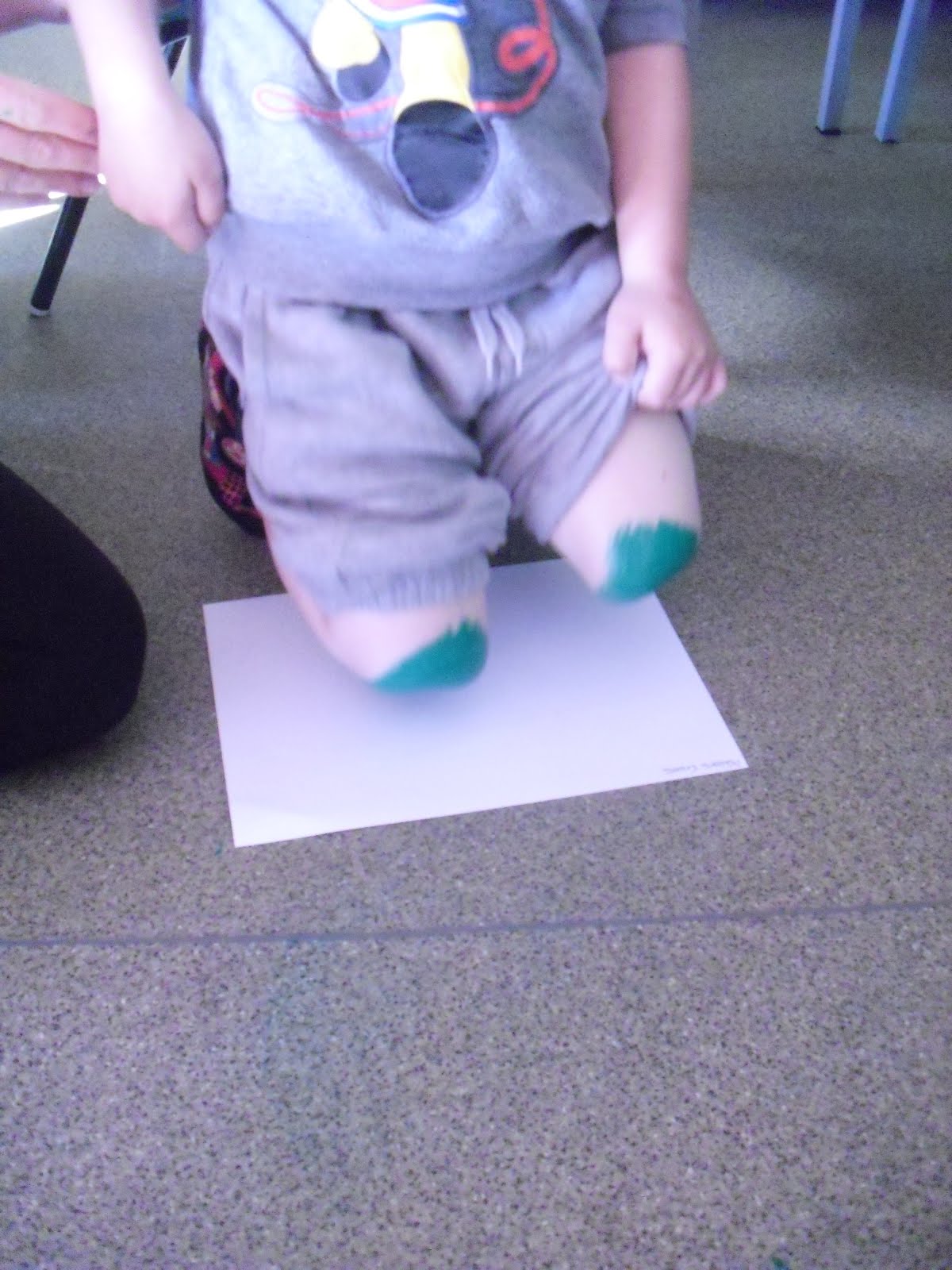
Simultaneously, there was a body painting activity going on. The children chose what body part they wanted to print onto paper with paint:


The body painting was so popular, we had to bring the activity outside for some collaborative foot printing:


The paint trays got a little slippery, so there may have been some painty bottoms! If you do this activity with your class, make sure you have some tubs of warm, soapy water, towels, and chairs handy for the clean up!

Speaking of clean up, always get the children to be responsible for cleaning up their own messes. It's their classroom, so they should be responsible for it to have a sense of ownership.


Phew. All that from a drawing of legs coming out of a head! And we're not done yet! The children have shown an interest and knowledge about bones and the heart. I'm hoping to extend their learning experiences with this interest in mind.

Note, these activities did not all take place in the same day. These occurred over the course of a week or so, always adding and extending learning experiences based on things the children said, did, or asked about.

25 March 2012

Displays: Their place in the learning process

To every teacher's dismay (or excitement), displays and bulletin boards are a necessary evil in the life of the classroom. Personally, I enjoy creating displays in my class - as long as I have the time! Through my internet travels, I've come across all kinds of displays and educator's ideas of what they should convey and how. I've happened across a lot of American teaching blogs which seem to put a lot of thought and effort into their bulletin boards and classrooms in terms of the theme:


colour scheme:


and all the tiny details to make the displays bright, cute, and fun.


There's even a website dedicated to bulletin board ideas! Great, right? I used to think so, and still do like some of those ideas (like keeping to colour scheme of backing paper consistent), but the more I looked at these ideas and gathered "inspiration", the more I thought, "Wait! Where are the kids in all this?" How were they involved in the creation of these displays? Did they get to make decisions on what the theme of the room was? Did they get to decide that all the walls were to be purple? or green? or pink? How are those pom pom things from the ceiling adding to their learning, other than, maybe, seeing how many chairs they'd have to stack before they could hit it with their hands (that's active learning, right?)? I bet that wasn't the intention when you spent all that time hanging them from the ceiling. Or did the kids help you hang them? Did they help you make them? Probably not.

source

My theory is, a classroom belongs to the children, not the teacher. Yes, it's my classroom because I teach in there, but my kids spend just as much time in there as I do, and they have to have ownership over the room. Why? Because they are the ones who are learning, not me. I believe if they walk into a ready-made classroom with a pirate theme, they will "oooh" and "aaah" for the first five minutes, and then it will all become a part of the background. White noise for the eyes. You may like it, but the kids were not involved in it's creation in any way. Would you have someone else come into your home and decorate to their liking? You would feel like a stranger in your own home. You would have no ownership over the stranger-decorated room. In fact, you may even be less likely to take proper care of the room.

I put my theory to the test in my own classroom, and allowed the children to have more input in what goes on the walls, even to the point of creating their own resources, like number lines, and alphabet flashcards. How many times does a child see "A is for apple" on a flashcard in their lifetime and say, "wow! That really helped me learn!" But I digress... Let's get back to the displays, and I will explain why I believe children should be involved in classroom displays through a journey of one of our creations.

About a month and a half ago, we were learning about the rainbow, the names of colours, and even coming up with more exciting names for colours (mauve is a new favourite). Over the course of about a week and a half, we painted in different ways, and as we talked about what we were doing, I recorded things the kids said as they worked. I took photos of the kids working as well.


Purple paint with sand mixed in made for an interesting talking point.


Driving painty cars across paper was a speedy exercise, and we even learned that red can also be called "rouge" or "scarlet."


Mixing colours to make secondary colours created lots of talk and learning opportunities. We also learned "olive" and "jade" as other words for green. We even had a discussion about our favourite veggies.


We used cotton buds to paint orange (or "peach" when we mixed in white to make it lighter).

Having really explored all the colours through colour-mixing, discussions, and different ways of painting, the children were able to come to a deeper understanding of colour and their names. I was able to photograph the children in their tasks, and record some of their conversation. Using these things, we were able to create a display of the rainbow that included their work, photos of them working, and speech bubbles of what they said when they were working:


I could have easily printed off or bought some ready-made resources and made something like this:

source

which, to be fair, has some great talking points and can easily be referred to when teaching (and that website does have some great ideas for art!), but would it not be far more engaging for the children to help create a display like that? Put their own work of warm and cool colours up on the wall instead of a generic ready-made print outs, and they are far more likely to remember what cool colours are!

Through the creation of our display, I was able to engage with the children and assess their learning and progress. Once everything was on the wall, the children loved going up to it and finding their photo (kids are vain, they like to see themselves in print! Use it to your advantage!). They were reminded of the activities we did, and I have even overheard them using our "new" colour words! The display is a reminder of their learning experience, and they are able to revisit it whenever they wish. Since they were involved in the creation of the display, they take more notice of it, and it is less likely to become "part of the background."

For more ideas on child-created spaces, check out:

ABC Does... - the scrapbook approach

ABC Does... - personalising the learning environment
ABC Does... - personalised teaching displays

06 March 2012

Colour Song Writing

Lately, my kids have been completely enthralled with music, instruments, and singing. They've created stages to perform songs, recorded themselves playing instruments, and sang at the top of their lungs.


Today, we used the old water-in-jars trick to create our own tunes, but with an extra twist. We added food colouring to the jars so each was a different colour.


Next, each child got a card with circles on it. They "composed" a song by colouring in the circles according to the colour of the water in the jar they wanted to "play."


When they were finished, they played their song!


We used a recordable photo album to record our songs. We took photos of ourselves playing our songs so we could put them in the photo album with our recorded songs.


Our song cards, photos, and album are now on display just outside the classroom for others to see and listen to.

This project was pretty successful. Both boys and girls were interested in taking part, even for just a few short minutes. My class is mostly boys, so I'm often trying to figure out ways to get them to do mark making and art projects. Since they've been so interested in music lately, I thought this would be a great way to get a crayon in their hand, while engaging their interest in music. The recordable album was a big hit too. They loved listening to their song (and in some cases, their voices as well!). They thought it was pretty funny to hear themselves; some were convinced it wasn't them because it didn't quite sound right. All in all, Colour Song Writing was a loud, colourful, and engaging activity!

26 September 2011

Colour Recognition

The other week, I came across a photo of this colour recognition/fine motor activity on Pinterest, so I decided to make a set for my classroom! I popped down to B&Q (just go to your local hardware store) to pick up some wooden clothespins and (free) paint chips to get started.


Make sure you pick up 2 of each colour paint chip because you're going to be cutting up one and keeping one intact.


You're also going to need scissors and glue. I started out by measuring the top of the clothespin and cutting out the pieces from one set of paint chips and gluing them on the clothespins. I realized that I wouldn't have enough clothespins for all the colours I chose, so I ended up cutting some shades off the "intact" paint chips.


I also realized that I could add a third learning opportunity to this activity! I only have 1 yellow, 2 red, 3 green, and so on. So not only will the children be practicing their colour recognition and fine motor skills, but they will also be developing their number skills!


When I got to school, I also laminated the paint chips so they last, and popped them in a basket with the clothespins. The kids had a blast matching them and they were really interested in discovering different shades of colours. One bright spark said as he pointed to the shades of green, "This one is dark, this one is lighter, and this one is lightest!" He was very pleased with his observation, and so was I!