Documenting children's learning is an important aspect of a child's education. Revisiting learning experiences allows pupils to talk about what they did with friends, parents and teachers, and they have a better chance of retaining what they've learned. There are countless ways to document learning experiences.
Mind maps are a good way to compile prior learning before starting a topic. It's also something you can revisit and add to throughout the topic.
Displays with children's work/models/projects with their words act as evidence of their learning.
Taking photographs of children engaging in their play is a great way to "save a moment." I often use these photos as part of a display in that area of the room, or in their individual learning journey books.
Having children involved in documenting their learning is another great method. I've had children help write labels as part of a poster or display.
Our planning format is a working document, which means we add to it on a daily basis. At the end of the week, we post it on the wall in the corridor for parents to read. We are well aware of the "forgetful-itis" syndrome that plagues most children when their parent asks them what they did at school that day. Yet another method to track pupil experiences.
What are some things you do in your class to document pupil's learning experiences?
26 January 2013
07 October 2012
Down by the Station
Boys and their trains. My afternoon class is absolutely smitten with anything with wheels - trains in particular. One wee guy always comes into Nursery exclaiming "trains! trains!" Naturally, the planning has made a shift over to trains and other wheeled vehicles to cater to this current interest.
We have an outdoor train set which the children love to build with. We also have an indoor one that uses Duplo trains. More often than not, the trains are out, and I really don't mind. Some people may think that the children need a different resource out to expand their learning and experiences, but they seem to do that all on their own with the same train set. They work together, construct complex tracks, problem solve when faced with challenges, and add in other resources to extend their play (like wooden blocks). If they're getting all that from a train set, and they aren't bored yet, why put it away?
As a result of this interest, trains and other modes of transportation has been incorporated in other areas of the curriculum to get them exploring different learning experiences. Using their interests to get them to explore things they wouldn't normally explore is a great way to get them involved. Some of my boys rarely go to the mark-making station, but when I put some trains and paint on that table, they were all over it:
You may notice I only had blue paint out. This was a conscious decision, as we are focussing on colour recognition at the moment as well. A lot of my kids really struggle to connect colours with their colour name, and I find they get a little less confused if we only have one colour out to focus on. Our language throughout the activity is based on the movement of the trains, the colour of the paint, and their experiences on trains and where they went.
We have a growing collection of cardboard boxes in our outdoor area (always a great open-ended resource to have on hand!). Naturally, the boxes became a train one day.
The children lined up the boxes, climbed in, collected tickets, and they were on their way! Some great language was happening here: ordinal numbers (1st, 2nd, 3rd), who drives the train, prepositional language (in front, behind, forward, backward), and discussion about where to go. They all agreed to go to the train station. Very practical.
We've been singing a wee song that I remember from my childhood:
Down by the station,
Early in the morning,
See the little puffer trains
All in a row.
See the station master
Turn the little handle,
Puff, puff, toot toot
Off we go!
Do you know any other train songs we could use to expand our repertoire?
We have an outdoor train set which the children love to build with. We also have an indoor one that uses Duplo trains. More often than not, the trains are out, and I really don't mind. Some people may think that the children need a different resource out to expand their learning and experiences, but they seem to do that all on their own with the same train set. They work together, construct complex tracks, problem solve when faced with challenges, and add in other resources to extend their play (like wooden blocks). If they're getting all that from a train set, and they aren't bored yet, why put it away?
As a result of this interest, trains and other modes of transportation has been incorporated in other areas of the curriculum to get them exploring different learning experiences. Using their interests to get them to explore things they wouldn't normally explore is a great way to get them involved. Some of my boys rarely go to the mark-making station, but when I put some trains and paint on that table, they were all over it:
You may notice I only had blue paint out. This was a conscious decision, as we are focussing on colour recognition at the moment as well. A lot of my kids really struggle to connect colours with their colour name, and I find they get a little less confused if we only have one colour out to focus on. Our language throughout the activity is based on the movement of the trains, the colour of the paint, and their experiences on trains and where they went.
We have a growing collection of cardboard boxes in our outdoor area (always a great open-ended resource to have on hand!). Naturally, the boxes became a train one day.
The children lined up the boxes, climbed in, collected tickets, and they were on their way! Some great language was happening here: ordinal numbers (1st, 2nd, 3rd), who drives the train, prepositional language (in front, behind, forward, backward), and discussion about where to go. They all agreed to go to the train station. Very practical.
We've been singing a wee song that I remember from my childhood:
Down by the station,
Early in the morning,
See the little puffer trains
All in a row.
See the station master
Turn the little handle,
Puff, puff, toot toot
Off we go!
Do you know any other train songs we could use to expand our repertoire?
30 September 2012
18 September 2012
Tiny Targets
I got this idea from a friend of mine who recently introduced it into her class. My class has been talking about their families and who lives in their houses, so a way for us to document what the children have said is to put up their photos on our Tiny Target poster with a speech bubble of their words. The actual target is laminated and blue-tacked onto the blue card so I can change the target easily as needed. I have laminated speech bubbles that I can easily write on with dry-wipe pens so I can reuse them.
I was speaking to my friend who came up with "Tiny Target," and she said she also made up stickers with the target typed on so she can easily pop them into their Learning Journeys/Portfolios/etc. as a permanent record of their progress. Super idea!
16 September 2012
Let the Children Jump
Jumping is such a simple and easy activity for children to do, and yet is offers so many benefits to their gross motor development, their health, and interacting with others (at least in the context my class were jumping in the other day).
Look at the line of children waiting for their turn to jump off the box. I had no involvement in this "rule" the children imposed on their play. They naturally came to the conclusion that the best way for everyone to get a shot at jumping without everyone clamoring in each others' way was to form a line and take turns. (Most) children have a natural inclination towards rules, right/wrong, and fairness. Watch them when they make up games independently of adult support. Rules are a natural addition to their play.
Jumping offers great gross motor development practice. The children experimented with different ways to jump off the box. Most chose to jump with both feet facing forward. Some adventurous types spun in the air, while others did the splits in the air! Some who were a little more hesitant, but wanted to join in the jumping fun, chose to simply step off the box onto the mat. Landing also offered great gross motor opportunities; keeping your balance after a big jump is quite a skill, and not all the children were able to master it yet. Fortunately, they loved doing a little roll on the mat as they landed.
Getting children away from the screens and moving around can be a challenge. Offering a stimulus for active play is often all it takes to get children moving. All I did was pop a few boxes outside with a mat and the children did the rest.
Happy jumping!
15 September 2012
The Body: Child-Led Learning
A few weeks ago, I wrote a post about mark-making which showed different stages of drawing people. One of the examples depicted people with legs coming out of their necks, which is quite a common thing for children to do when drawing people.
As a result of this, I thought a good way to progress the children's understanding of the body would be to look at it a little closer and learn about all the different parts. First, we traced someone's body:
Then we made a mind map of what we know about the body. Unfortunately, I don't have a photo of the mind map right now, but essentially, it says "bodies" in the middle and the children drew pictures, shared ideas, and wrote words all about the body. One wee boy said that we all have a love heart in our bodies! Another boy prefers writing to drawing, so he wrote words like "feet," "chin," "back," "eye," "eye," (yes, twice, because we have two eyes) "body," and "nose." He wrote it all with minimal support!
Next, we took photos of different parts of our body. The children were in charge of deciding what body parts to photograph and they were in charge of actually taking the photo. The more responsibility the children have, the better.
After we printed the photos, some children helped to make labels for them and we stuck them up on the cut out body tracing on the wall.
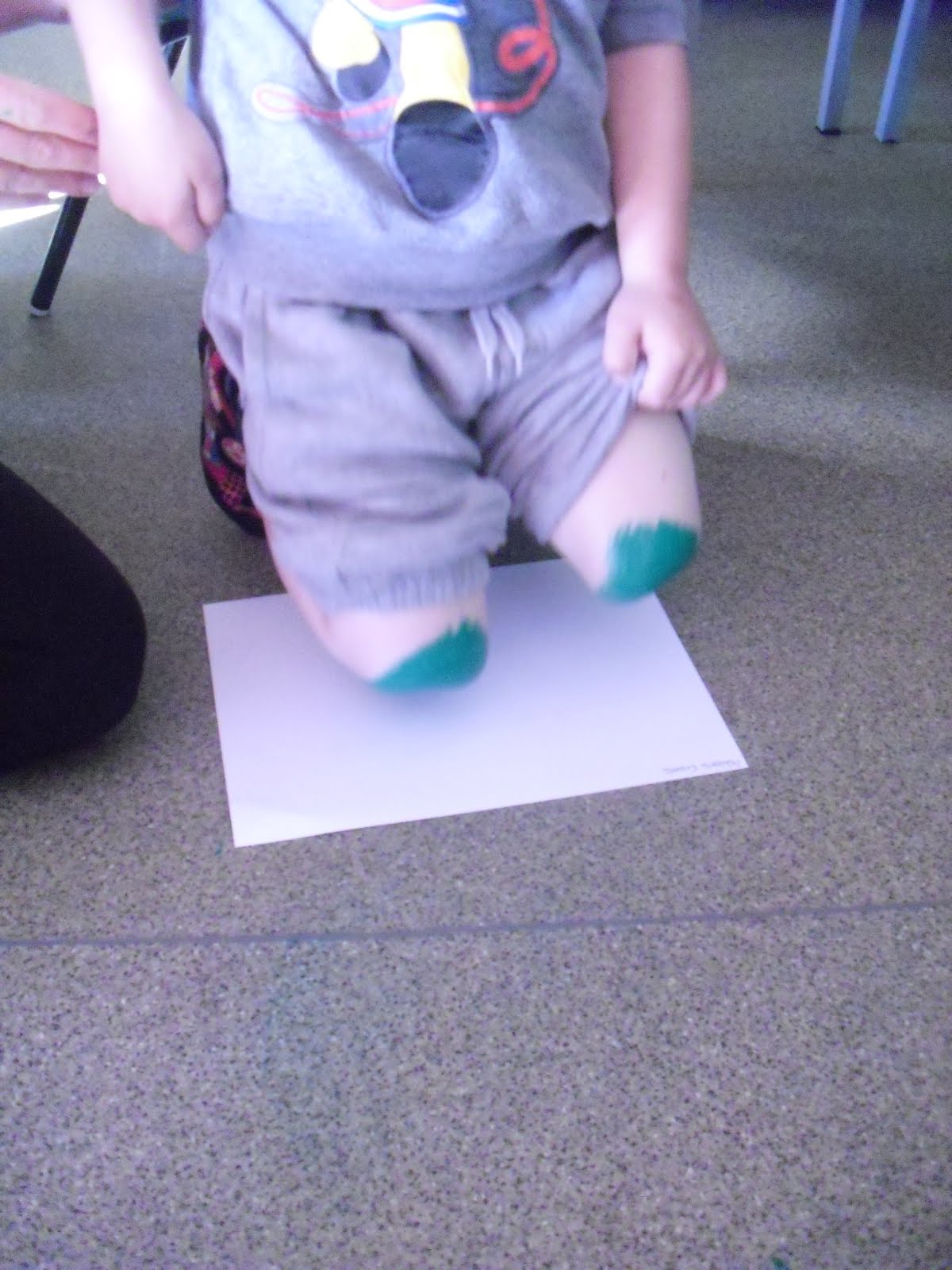
Simultaneously, there was a body painting activity going on. The children chose what body part they wanted to print onto paper with paint:
The body painting was so popular, we had to bring the activity outside for some collaborative foot printing:
The paint trays got a little slippery, so there may have been some painty bottoms! If you do this activity with your class, make sure you have some tubs of warm, soapy water, towels, and chairs handy for the clean up!
Speaking of clean up, always get the children to be responsible for cleaning up their own messes. It's their classroom, so they should be responsible for it to have a sense of ownership.
Phew. All that from a drawing of legs coming out of a head! And we're not done yet! The children have shown an interest and knowledge about bones and the heart. I'm hoping to extend their learning experiences with this interest in mind.
Note, these activities did not all take place in the same day. These occurred over the course of a week or so, always adding and extending learning experiences based on things the children said, did, or asked about.
08 September 2012
Natural & Open-Ended Resources
How many times have you set out resources for your kids to use, and they haven't used them according to your expectations? How often do we see educational toys that are designed with only one use in mind? Pirate ship play-grounds can be exciting and look really neat, but they limit the type of play that can occur. A pirate ship play-ground will ultimately result in pirate play. There's nothing wrong with pretending to be a pirate. I can "yar me harty" with the best of them. But as educators, we should be encouraging children's natural curiosity, creativity, and need to explore, and one of the best ways we can nurture that is through open-ended resources.
With open-ended or natural materials, children can explore, create, imagine, and learn through play without the resource dictating what their play should be. I'm always surprised at what children's imaginations come up with; it's often not at all what you intended, and that's okay!
After a short "stick safety" chat, the children had free reign of our collection of sticks, branches, driftwood, and medallions. Someone discovered the flower box and decided to add a floral finishing touch to their creation.
Sadly, children don't always have the opportunity to use their imaginations in their play. With video games, computers, and ready-made toys, children have all the heavy lifting done for them.
With natural and open-ended materials, children can do the heavy lifting all on their own.
Or with a little help from a friend.
Subscribe to:
Comments (Atom)