26 August 2012

A Seashell


J. found a shell in the garden! What a great discovery. He noticed the lines on the shell, and imagined it came from a place called "Shell-land."


J. found another shell in the sand pit. It had dirt stuck inside it. He used the first shell as a spade to dig it out, and rinsed them in the sink.


At Circle Time, the children gathered to look at, feel, and smell the shell. Some children said they've seen shells at the beach, others said the shell felt rough and had lots of lines. We had some great discussion about what the children like to do at the beach and who they go with. We even had some discussion about how the seashell came to be in the garden. Some children thought a seagull dropped it there. All the children had something to contribute because it was something they could all relate to. It was great having an impromptu Circle Time with the children about one of their own discoveries. That's was Pre-School should be about.

25 August 2012

Class Tour - better photos

I took some better photos of my new classroom this week!


This shot is looking to the story corner, construction center, and art table.


Small World and puzzles table, with the role play corner behind it. To the right, there's a door to the Nursery garden! I love that we have direct access from the classroom to the outdoor space.


The story corner has a lovely new carpet. The children like to choose a minibeast to sit on. I love that we have a Smartboard, too. I'm so excited to integrate it into the children's experiences!


The art/writing area is so organized, thanks to my Nursery Nurse! Hopefully it stays this way! I've really been on at the kids this week to make sure they look at where materials belong and put them back in the right spot. I really think it's important to make the children responsible for their space.


There's a huge whiteboard right by the art table. The children have decided to put up some of their drawings from the first week of school. I have some talented artists on my hands!


We have a HUGE role play corner. The children are quite imaginative compared to my class last year. They love role play. It's interesting to watch them interact with each other.


I love this shelf. One side holds resources for the water table, one side holds resources for the sand table. The children choose for themselves what they want to use and take it to the sensory tables themselves. I'm striving for the children to be independent in their learning experiences and in the general operation of the classroom.


Since my classroom is massive this year, I have the luxury of having this great double easel! One side is for painting and the other is a whiteboard. I love that 3 children can work easily and comfortably at the easel.


The resource boxes are clearly labeled with text AND photos so the children know where things belong and can put away resources independently. It's important for children to see the text as well, despite not being able to read yet. I strive for my classroom to be a text-rich environment so children become familiar with it as they begin to mark-make and write.


Every class in the school received their own huge floorbook to contribute to throughout the year. My children are heavily involved in deciding what goes into it and what they want it to say. This particular page documents our class trip to the Bear Factory where we chose a new outfit for our class bear, Dora. We took a city bus into town and everything! The children were able to talk about waiting for the bus, how to cross the street, and what landmarks the recognized on the way to town.


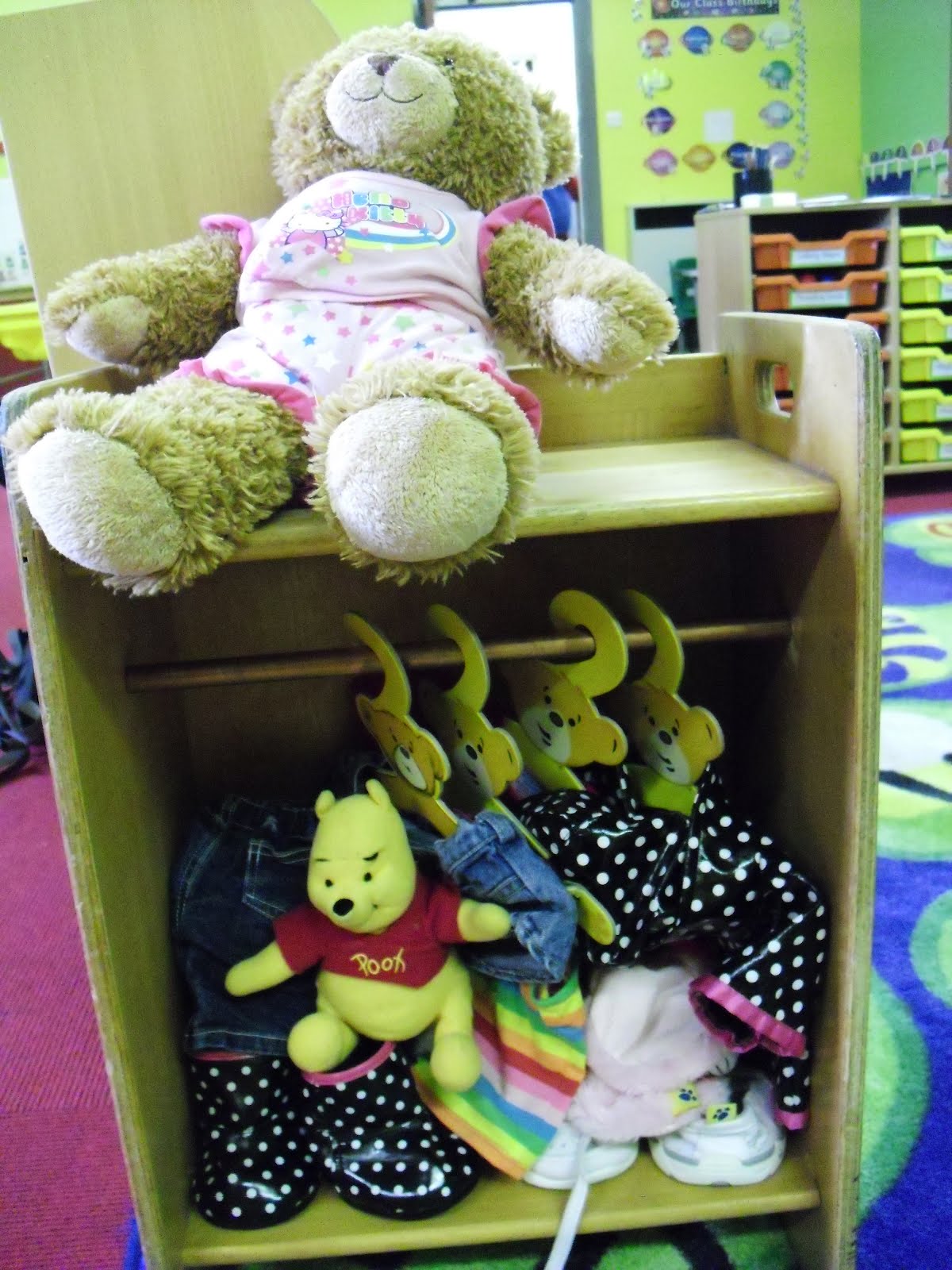
Here's Dora, our class bear! She has QUITE the wardrobe! What you see here isn't the half of it! The kids love dressing her up and using her in role play.


This year, we've started a new teeth-brushing method with Brush Buses! I LOVE these. They are so much better than the children having individual boxes with their toothbrush in it. Each child has a picture (apple, milk, strawberry, etc.) that corresponds with a toothbrush with the same picture. They have been really good with putting their brushes back in the right spot!

That's it for the updated tour with better photos!

19 August 2012

"The Rules"

source


Ah the dreaded First Week of School when you need to start right back at the beginning. You forget how much work it is to get back into a routine, settle the children into school, and establish "The Rules." My school actually has established Golden Rules that are to be followed by the whole school, but I still think it's important to discuss your own class rules so everyone knows what the expectations are for the classroom. So how do you go about doing that?

I've seen this done in different ways. Of course, there's the list of "don'ts" that clearly state your aversion to gum chewing and interruptions. Naturally, you want children to know what they aren't allowed to do in class, but in my experience, kids already know the don'ts, and they don't like hearing the word "no." Children respond to positive language. Don't you?

Be Positive.

Keep your "rules" positive. Instead of saying "Don't hit others," simply change that to "Be kind to others." That simple statement covers a multitude of sins (hitting, name-calling, exclusion, etc.), that way you don't need to list every little offense that a child might commit. One teacher I know only has two rules in the class. They are 1. Show respect (to yourself, to others, to property) and 2. Do your best (best teamwork, best work, best thinking). I love that the kids only have two things to remember, and the rules are broad enough to cover almost everything.

Include the Children.

This may be old news to most of you, but I still think it's worth talking about. Establishing the rules of the room should be led by the children, not you the teacher. Kids know to put up their hand to talk. They know not to hurt people. They know they need to try their best. They know not to eat the glue (for the most part). They will give you EVERYTHING you want to hear. And if you give them the responsibility to remind YOU and EACH OTHER of what those rules are, they will take that responsibility VERY seriously. What they come up with may need a little narrowing down, and that's where you come in. I don't think it's necessary to put "no picking your nose" on the final copy (or maybe it is?).

Rules.

To be honest, I'm not really a fan of the word "rules." I'd much prefer to go about this task in a more positive manner, telling the children that we are creating a Class Promise or Full Value Contract or Code of Conduct (depending on the age of your class). Despite the age, I think it's important to get the children to "sign" the Promise, even if they are still at the pre-writing stage.

Consequences

I'm a firm believer in natural consequences. I hate the idea of time out (I do believe in taking a break, but I will get to that in a minute). If a child is doing something where they could potentially get hurt (like balancing on blocks), and they eventually fall and get hurt, that is a natural consequence. I wouldn't take them away from the blocks; they would have learned already that balancing on blocks can be dangerous and to be more careful next time. Let children learn from their mistakes. Side-note: As as adult, I would obviously not let a child take a risk that I felt was dangerous.

Obviously, if a child is hurting someone else, I would take them away from the situation, but not to a time out. In my experience time outs aren't very effective. They are a temporary solution where the adult rarely puts any input into the solving of the problem. Even for 3 year olds, it's important to talk about what happened, remind them of the Class Promise, and relocate them to something or someone different, NOT to a specified "time out". Sometimes kids just need a break from each other. I have a "Breath Box" in my class, if necessary. It's full of things like playdough, stress balls, photographs depicting different emotions, sensory bottles, paper/crayons, bubbles, etc. Sometimes, a child just needs a few minutes to themselves to regroup, breath, and exert some of that emotion on some playdough.

With older children, I would even have a go at having them come up with some consequences. Sometimes, they can be a little more harsh that I would ever be! If they decide on the consequences, they may be even more likely to behave according to the class's Code of Conduct (or Promise, or Full Value Contract...).

Rewards.

I don't want to dwell too much on consequences because I think it's even more important to focus on, and reward those who are doing exactly what they should be. I'm not talking about a Treasure Chest of Poundland rubbish, but about natural or non-tangible rewards. Sounds exciting, right? It can be! A simple, "my you're sitting smartly!" can sometimes be all it takes to motivate a child to continue doing what they're doing (and encourage those around them to as well). Sometimes it can be easy to forget about those children who are always following the "rules" because they aren't being disruptive. Don't forget to see those kids and recognise that they are fulfilling the Class Promise.

See Behaviour 101 for some other ideas on how to manage behaviour in your class.

How do you establish "The Rules" in your class?

16 August 2012

New Classroom Tour

It's that time of year again when it's time to drag your feet back into the classroom to set up! Much to my delight, when I walked into my new room, most of it was already done! A couple of the Nursery Nurses at my school worked through the summer, so they took the liberty of organizing toys, labeling boxes (complete with pictures of what's in the box!), and generally setting up the furniture. When I first walked in, I thought, "Oh, but I wanted to set up the room," but after looking around, it was really the only way for the room to be set up anyway because of where the carpeted flooring and linoleum flooring was, and where the Smartboard was already mounted. Those things really dictate how you can set up a room. So, even though I didn't get to set up the room, I am delighted with how it looks!

This year I am teaching Nursery (that's Kindergarden for all you North Americans!). I have two classes - AM & PM - adding up to 40 children in total! That will be interesting during report writing time!

Here are some poor quality mobile phone photos to show what the room looks like so far, before the children have stormed through.


Really, the only major thing that I needed to do was organize the filing cabinet. It still had some things in there from 2007 (not as bad as my classroom last year that had files lying around from 1998!). The filing cabinet is really the only place in the room for me to keep personal files/resources, as well as general office supplies (scissors, pens, stapler, etc.), so I spent some time reorganizing so I know exactly where everything is.


I'm almost finished organizing files. I've used folder dividers to subdivide paperwork, masters, resources, etc. This way it's easy for me to find or file things quickly. Hopefully it will stay this organized for the year! We'll see...

Have you been into your classroom yet?

02 June 2012

Behaviour Management 101

Teaching is far more complex and involved than just teaching a child how to read or write or add numbers together. In this generation, teachers are psychologists, nurses, mums, dads, counselors, crowd control, entertainers, nutritionists... you name it, we do it. When I was in Primary School, I don't remember teaching being so centered around managing children or catering to their well-being in addition to their academic progress. In my teaching day, I spend just as much time, if not more, caring for children's additional needs (helping solve problems, ensuring they have jackets/shoes/lunch/etc., comforting them) and managing behaviour as I do actually teaching. That being said, behaviour management is necessary and vital to creating a sustainable and productive learning environment.

Teachers have many different strategies to managing behaviour, from simple praise to stickers to elaborate whole class systems. This post will include strategies that I have tried in my own classroom, plus other ideas that I'm hoping to try in the future that I've discovered through internet travels and professional development courses.

1. Bribery. There's nothing wrong with a little incentive to do a good job or behave appropriately. I'm a firm believer in the power of stickers. I would never say, "if you sit still, I will give you a sticker." I would, however praise by proximity - meaning, if someone is doing as they should, I would praise them, pop a sticker on their jumper, and hopefully the undesired behaviour of those near them will stop. Kids naturally want to please you (and get stickers), so this works most of the time.

This image is from Primary Teaching. You can purchase stickers, stampers, and certificates, and you also have the option to personalize them! I've ordered them before and they are great quality.

This is a sticker I've ordered before from here. You get 96 30mm personalized stickers for £2.40 with FREE delivery. Brilliant! The easy-to-use tool allows you to choose background colour, clipart, message, and font.

2. Whole Class Behaviour Chart. A lot of classes use this strategy to manage behaviour. I've used it and seen it implemented in different ways. In the past, I have created a behaviour chart based on a topic theme. For example, a topic we did last year was called, "Healthy Bodies, Healthy Minds, Healthy Me" and each pupil designed a runner with their name on it and placed it in the middle of a race track. Each section of the race track was a loss of time in increments of 5 minutes. Pupils would move their runner onto a specified place on the track as poor behaviours continued. The last 30 minutes of a Friday afternoon is called "Golden Time," where pupils can do a choice activity. If, throughout the week, they have lost minutes, they are made to do some sort of task before they can start Golden Time. Something I didn't like about this system was that it didn't leave room to improve because all pupils started the week with 30 minutes of Golden Time, which is why I designed this system:


The Bird Themed Behaviour Chart is designed with 7 different stages on the behaviour chart and pupils start each day or week in the middle stage, and can move up and down the chart as behaviours change. It's up to the teacher what rewards and sanctions occur at each stage. It could be loss of Golden Time if that's something you use in your class, it could be a phone call or note home, and rewards could be extra Golden Time, a choice activity, or a note home. The pack that I created comes with the images for each stage, a letter home to parents explaining how the system works so they can discuss it with their child, and a chart that can go home each day to show where on the chart the pupil finished their day, in an effort to keep lines of communication open between parent and teacher. Let's be honest, children aren't always going to tell their parents that they got into trouble!


Here are other ways that I've seen the Behaviour Chart used in classes:

source


source

source

3. Secret Student or Mystery Person. I've seen this floating around the blogosphere a few times being used in different ways. Basically, you secretly choose a pupil at random and the class doesn't know who it is until the end of the day. If that person behaved in line, did as they were asked the first time, didn't interrupt, etc., then they gain some kind of reward (name & photo on a wall of fame wall, extra choice activity time, or it could be a whole class reward to help pupils work hard not only for their own benefit, but for their classmates' benefit as well). You can write pupil names on lolly sticks to help you choose randomly, and you can reveal the name at the end of the day IF they behaved throughout the day. If they don't deserve to gain the reward, don't reveal the name. Also, you can choose to focus on a specific behaviour that your pupils need to improve, e.g. standing in a straight line, raising hands to speak, tidying tables, etc.

source

4. Puzzle. When I was on a teaching placement, my mentor teacher used a puzzle to encourage the children to walk through the school hallways quietly and in line. She attached velcro to the back of puzzle pieces and stuck a piece of card with the velcro bits on the wall. Every time the class got a compliment in the hallway from another adult on the way they were lined up and walking, they got to add a piece to the puzzle. When they completed the puzzle, there was some kind of whole class reward. You could use this strategy to encourage any behaviours that need improvement.

source

Similar to the puzzle, I've also seen Mr. Potato Head being used! How cute is that?

source

5. The Big Green Monster. If you're in lower primary, you may just have a few tattletales on your hands.

source

Children take a piece off if they decide their tattle is worth telling you. For every piece of the monster that's left by the end of the week, you put marbles in your jar (or whatever your class management scheme is).

6. Happy Rocks. These are made with vase stones and drawn on with paint pens or sharpies. You can use them as whole class incentive or group incentive where children earn a happy rock for desired behaviour. Fill the jar, earn a reward.

source

7. Table Points. Last year, my pupils sat in table groups. Throughout the day, they earned table points for desired behaviour (keeping tidy, raising hands, etc.). Table points were rewarded as maths counters.


Each table earned a different colour of counter (so no stealing from other tables) and kept the counters in containers at the tables. The table with the most points at the end of the week earned extra time for choice activities (Golden Time, we call it). With this particular class, I was having problems with them consistently asking to go to the toilet or get a drink from the fountain (aka wasting time). To curb incessant "can I go to the toilet? Can I go to the toilet?" children had to "pay" a table point in order to go. Pupils had to think twice about whether they really had to go, and they didn't want to lose the chance to earn extra choice activity time. Because it was a table groups incentive, there was added peer pressure.


What are some strategies that you've used in your class?

27 May 2012

Class Displays

These are a few of the displays I've had up in my class this year:

This is our scrapbook approach to showing the process of building our volcanoes.

I wrote a previous post on making songs using the water-in-the-jar trick. This is part of our display showing our colour songs.

We used a recordable photo album to record the children playing their songs, and include a photo of them playing their song.

"Banana" by Ed Vere is a firm favourite picture book in our class. The kids love it because they can "read" it. There are only two words in the whole book: "banana" and "please." It's a great book for teaching children about looking at the pictures for clues to infer what is happening in the story. We looked at things like colour, line, and facial expression to figure out how the monkey in the story was feeling when he didn't have a banana. We say "banana," we cry "banana," we SCREAM "BANANA!" It's great fun. As a result of all the interest, some of the children decided to paint the monkeys from the story.

As I've mentioned before, my kids love to paint, and we always look for new ways to use the medium to create. The process is so much more important than the end product sometimes. In this display, you can see some of the children's paintings they made using cooked spaghetti. Often, I put up a wee sign to explain what we did. I also pop up photos of the children doing the activity. That way, parents can see what they've been up to, and kids love to look for themselves on the wall.


What have you put up on your classroom walls?